

4 Million NOTAMs: What Happens After an Airport Closes
9/12/2026
We processed and interpreted 4,000,000 NOTAMs. This review examines what airport and airspace notices told operators as restrictions changed, and where those notices needed additional context. It follows our three-million review.
Jakarta’s reopening estimate kept moving
When Anak Krakatau erupted in early September, ash forced airport closures across Java and Sumatra. Indonesia’s meteorological agency, BMKG, reported eight airports temporarily closed by the morning of 7 September. BMKG’s update.
At Jakarta’s Soekarno-Hatta Airport, the first closure notice gave an estimated end just 3 hours 22 minutes after its start. Eight replacements followed before a notice announced reopening for 7 September.
One of those updates was issued just eight minutes before the previous estimated end. It pushed that estimate back by another four hours. An airline planning around the earlier time had another change to account for before it could send an aircraft.
This is why a reopening estimate can be so difficult to use. The first notice could tell an airline when the restriction was expected to end. It could not tell the airline whether the ash would allow that estimate to hold. In this case, the answer kept changing.
Reopening also came with a warning. Soekarno-Hatta’s notice said the airport had resumed operations, then reminded pilots that volcanic ash remained in the surrounding airspace. Halim Perdanakusuma’s reopening notice carried the same warning.
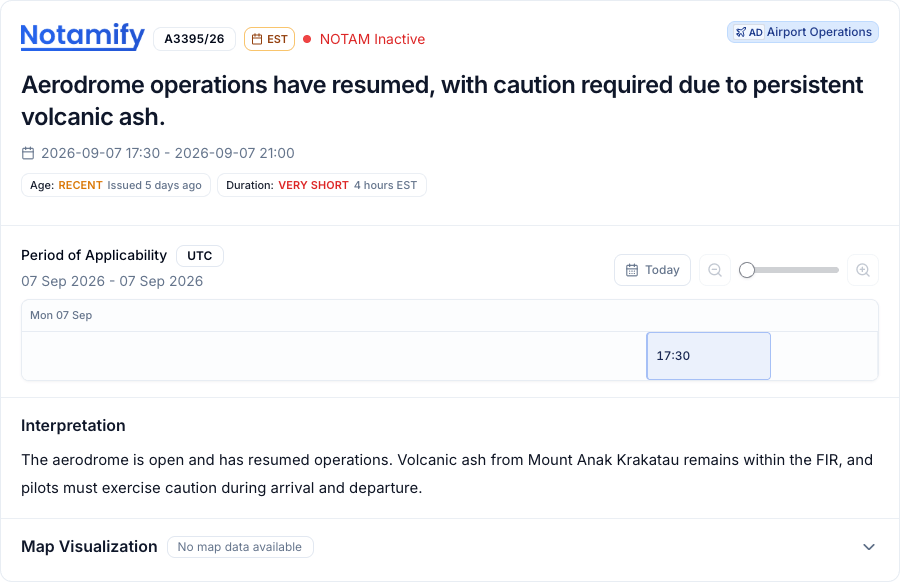
The airport was available again. An arrival or departure still had to account for ash along its path. A passenger hearing that the airport had reopened could reasonably expect progress, while the airline still had more to assess before operating the flight.
The fatal crash at Miami
Five people were killed in the crash of 21 Air Flight 7598 at Miami International Airport on 6 September. The NTSB is investigating the accident. AP reporting, NTSB investigation.
The notices reviewed here describe the operational aftermath. They do not establish why the accident happened.
Among 337 Miami records issued from 1 to 11 September, none contained the words “crash” or “accident” in either original text field. The consequences were nevertheless recorded through runway restrictions and traffic-management alerts. One alert directed readers to a separate FAA message.
That FAA advisory described a ground stop associated with a disabled aircraft and instructed operators to plan for restricted arrivals when the airport reopened. The planned ground-delay program would allocate arrival slots and hold incoming aircraft at their departure airports to match Miami’s capacity. FAA advisory, FAA ground-delay procedures.
For crews and dispatchers responding to the aftermath, the runway notices and the FAA advisory provided different parts of the operational picture. The absence of the word “accident” in the NOTAMs did not mean the airport was operating normally.
A closure in one country changes routes in another
In less than three hours on 28 February, closure notices took effect across the Tehran, Tel Aviv, Baghdad, Doha and Kuwait airspace regions. The notices had different exceptions, including permission for specified flights in Tel Aviv. The rapid sequence followed the escalation of the conflict involving the United States, Israel and Iran. EASA’s account of the escalation.
Two days later, a notice issued for Saudi Arabia’s Jeddah airspace set out alternative routes because Amman airspace in Jordan was closed. The operational change appeared in one country’s notices; its stated cause was in another.
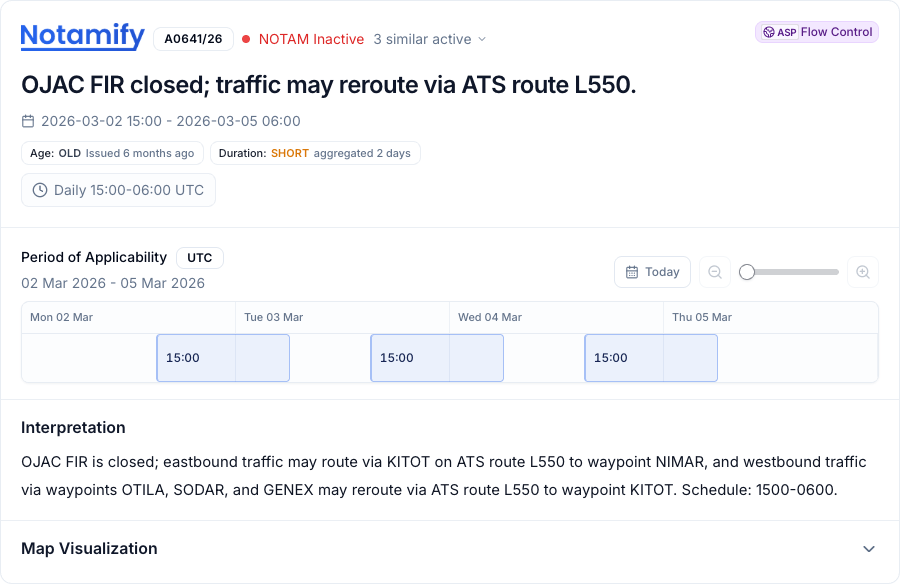
For an airline, checking the departure and destination airports would not reveal that problem. A flight can need a different route because of a country it only passes through. Following a disruption means following those connections across the journey.
Even where flights were permitted, the answer could depend on when and why they were flying. An Iranian notice on 2 June allowed daylight operations at a group of airports while making nighttime exceptions for Haj flights at three of them. Civil passenger flights required fresh permission. A regular passenger service and an approved Haj flight could therefore receive different answers for the same airport at night.
Five days later, another notice stated that all airports in the western part of Tehran’s airspace region were closed. The conditions under which flights had been permitted earlier that week had changed again.
Skymerse is flight operations on autopilot
Skymerse monitors conditions, plans flights and processes everything your team would otherwise have to find and review.
Sign up for a demo to see how it works for your routes and fleet.

Read more...
Your AI Agent, Connected to Notamify
10/20/2026
Use Notamify coverage, interpretations and briefings in Codex, ChatGPT and Claude. Connect with your existing account and manage access in Notamify.
Track Starship NOTAMs and Restrictions
9/27/2026
Explore Starship launch restrictions, route closures and re-entry NOTAMs on one map, with notices grouped by airport and flight information region.
Faster Flight Briefings and Automatic Airport Summaries
9/25/2026
Flight briefings now generate 47% faster with improved accuracy. Airport summaries take around few seconds, with a new Auto option for airport pages.
NOTAM App for Pilots on iPhone and iPad
7/24/2026
Notamify is a NOTAM app for iPhone and iPad with clear interpretations, runway and taxiway maps, flight briefings, offline access, and swipe review.